
A forecast helps you choose a night and a place. On a tour the guide looks at the same cloud and activity data on the evening and picks the route.


Kp describes the whole planet
The planetary K index is built from magnetometers around the world and given for three-hour intervals on a scale from 0 to 9. The Geophysical Institute at the University of Alaska Fairbanks explains that it averages the activity of around eight stations. NOAA's Space Weather Prediction Center starts its storm scale at Kp 5, which it labels G1, and ends it with G5 at Kp 9.
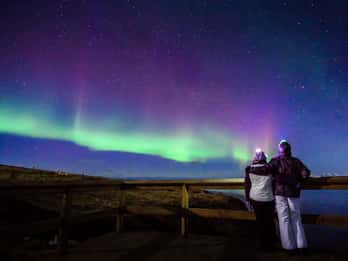
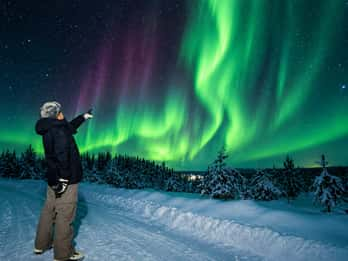
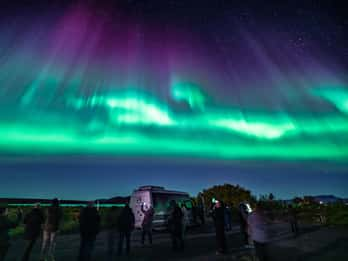
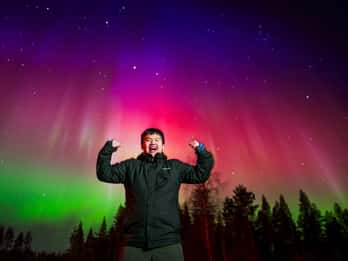
NOAA also says what the numbers mean for someone watching. At Kp 0 to 2 the aurora stays far north and is dim. At 3 to 5 it moves further from the pole, gets brighter and moves more. At 6 and 7 it is bright and active, and at 8 and 9 it reaches far towards the equator. NOAA adds that these relations are averages and do not always hold.
Inside the oval, the sky matters more than Kp
NOAA ties Kp to the edge of the auroral oval on the side of the equator, measured in geomagnetic latitude and not in the latitude on a map. The edge lies at about 66° at Kp 0, moves down about 2° for each step and reaches 48° at Kp 9. The Geophysical Institute puts the quiet oval at 67 to 68° and says that inside it Kp is less relevant, because activity can be high while the global index is low. Visit Tromsø says that Tromsø lies directly below the oval and that research shows little effect of solar activity on the displays right under it.
NOAA's own advice fits this: from the right place even Kp 3 or 4 gives very good displays, and from a hill with an open view north you can see aurora that is up to 1,000 km further north. The box on the place pages counts the oval as reaching Tromsø even at Kp 0, and Rovaniemi from a Kp of about 1.4. At those places the clouds decide most nights, and that is why guides drive.
Clouds hide the lights
The Geophysical Institute gives about 100 km as the lower edge of the aurora, so clouds below it block the view. Visit Tromsø writes that the weather in the north changes quickly and that a hole in the clouds can open up. Its guides watch weather, cloud cover and activity and take the group to the area with the best chances that evening, sometimes far out of the city and occasionally as far as Finland.
What guides do with the forecast
The listings describe the same routine. Lights Over Lapland in Abisko writes that its guide combines local weather and aurora forecasts to decide where to look and drives up to 100 km for the round trip. Arctic GM Experiences in Levi says it monitors weather and solar forecasts and does not start the tour under extremely unfavourable conditions. Lapland Explorers in Rovaniemi gives a departure between 18:00 and 21:00, depending on forecasts and space weather. What a tour offers when the lights stay away is covered in second chances and guarantees.
How far ahead a forecast works
NOAA's 30-minute forecast, based on the OVATION model, gives a lead time of 30 to 90 minutes, the time the solar wind needs to travel from satellites about 1.6 million km upstream to Earth. The 3-day forecast is issued every 12 hours. The Geophysical Institute notes that material leaving the Sun takes 1 to 3 days to arrive, which allows fairly accurate forecasts on that scale. The 27-day outlook uses the fact that the Sun turns once in about 27 days, so a coronal hole that caused activity can return. The institute labels it less reliable.
How the box Northern lights tonight is worked out
The box on every place page has four parts. The forecast Kp comes from NOAA's Space Weather Prediction Center, in three-hour steps. The cloud cover comes from MET Norway, the Norwegian weather service, and is the average of the hourly forecast. Both are fetched again every two hours, and the box disappears if one of them does not answer or is more than three hours old.
The box looks at the evening window from 18:00 to 01:00 local time. The part called Dark enough shows when the sun is more than 12° below the horizon, which is the end of nautical twilight. The window starts no earlier than that, and in summer, when the sun never gets that low, the box does not appear.
The chance is Good, Fair or Low. Cloud cover is read in eighths of the sky, as in the weather code used at airports: up to 2/8 counts as good, 3/8 to 4/8 as fair and 5/8 or more as low. The box then takes the highest Kp of the window and checks where NOAA's oval edge lies for it. If the edge lies north of the place but within 4°, the lights would sit low on the northern horizon and the chance drops one step. Further north than that it is low. The box does not account for the moon, city lights, the solar wind in real time or the 30-minute forecast. It is an estimate.
Season, hour and moon
NOAA says the best aurora usually comes within an hour or two of midnight and spreads towards the evening and morning when activity rises. It also notes that storms tend to be larger around the equinoxes, but that the nights then change quickly, and that a full moon dims the apparent brightness. The Geophysical Institute puts the chance over Interior Alaska at about twice as high at the equinox as at the solstice and gives 21 August to 21 April as its viewing season for Fairbanks. Visit Tromsø and Visit Rovaniemi both give late August to early April.
On 15 October 2024 NASA and NOAA announced that the Sun had reached the maximum period of its 11-year cycle and expected it to last about another year before the declining phase. NOAA adds that fairly large storms are also seen in the declining phase, and the Geophysical Institute says activity tends to peak about a year after the maximum. For a place inside the oval the cycle matters less, as Visit Tromsø points out.
Questions about the aurora forecast
Which Kp do I need?
It depends on where you stand. NOAA says that from the right place Kp 3 or 4 is enough for very good displays. Inside the oval, the Geophysical Institute says Kp is less relevant, and for Tromsø the box already counts the oval as overhead at Kp 0.
How far ahead can I trust a forecast?
The 30-minute forecast and the 3-day forecast are the useful ones. The Geophysical Institute calls the 27-day outlook less reliable. Use the 3-day forecast to pick a night and the cloud forecast on the day to pick a place.
Does the box Northern lights tonight promise lights?
No. It combines the Kp forecast with the cloud forecast for the evening hours and shows an estimate. Tours go out in any case, and a chase can find a gap that the average hides.
Why is the box missing on some days?
It disappears when one of the two forecasts did not answer, when the data is more than three hours old, or when the sun does not get 12° below the horizon that evening, as in summer.
Does a full moon spoil the lights?
NOAA says a full moon dims the apparent brightness of the aurora. Northern Soul Adventures, a Tromsø operator, writes in its listing that around the new moon the sky is darkest, and that at full moon the lights look fainter but the landscape is lit, which helps photographs.
Is the solar maximum the best time to go?
More activity helps at the edge of the oval. For a place inside the oval Visit Tromsø says solar activity has little effect, and NASA and NOAA note that fairly significant storms also come in the declining phase.
Sources for this page
Tour details come from the listings on the booking sites. Everything else is from the pages below.
- NOAA SWPC: tips on viewing the aurora (Kp, oval, hours, equinoxes, moon)
- NOAA SWPC: planetary K-index and storm scale
- NOAA SWPC: aurora 30-minute forecast (OVATION)
- NOAA SWPC: 3-day forecast
- Geophysical Institute, University of Alaska Fairbanks: aurora forecast and FAQ
- Visit Tromsø: when and where to see the northern lights
- Visit Tromsø: northern lights tours
- Visit Rovaniemi: northern lights
- NASA and NOAA: Sun reaches maximum phase of its 11-year cycle, 15 October 2024
- MET Norway: licence and data policy
- Wikipedia: METAR, cloud cover in oktas